





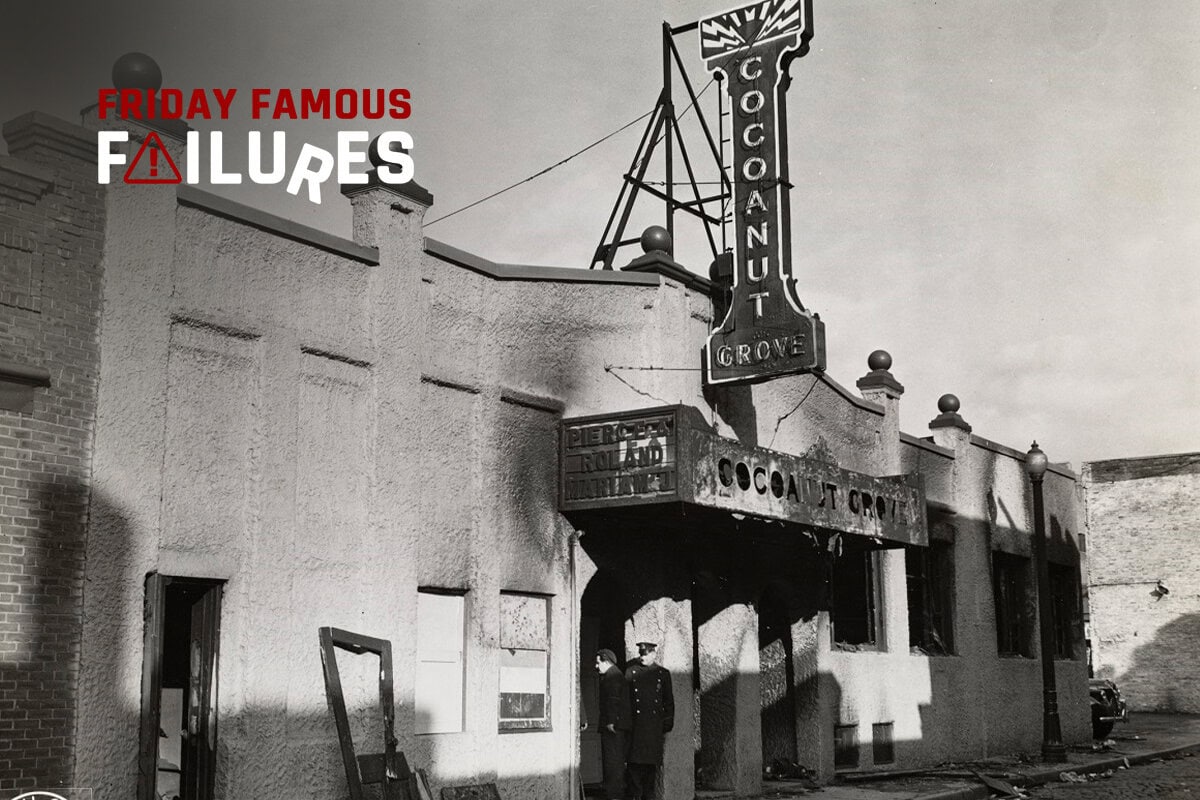
Date: November 28, 1942
Location: Boston, Massachusetts
Facility: Cocoanut Grove nightclub
Outcome: 492 people killed; hundreds injured
Primary failure mechanism: Rapid fire and smoke spread through an overcrowded assembly occupancy with inadequate, obstructed, or poorly functioning exits
On the night of November 28, 1942, the Cocoanut Grove nightclub in Boston was crowded with patrons celebrating the holiday weekend, wartime leave, and a major local football upset. Within minutes, the popular nightclub became one of the deadliest building fires in American history.
The fire began in the lower-level Melody Lounge area and spread with extraordinary speed through the building’s decorated interior. Flames, hot gases, and dense smoke moved from the basement lounge into corridors, stairs, bars, dining areas, and the main floor. Many patrons were not burned in place by a slow-moving fire. They were overcome while trying to understand what was happening, find an exit, or force their way through blocked or jammed doors.
For engineers, the Cocoanut Grove fire remains a defining life-safety case study. The disaster was not only a fire problem. It was an egress problem, an interior-finish problem, an occupant-load problem, an enforcement problem, and a systems problem. The building did not give occupants time, information, or usable paths to escape.
A Nightclub Designed for Atmosphere, Not Emergency
The Cocoanut Grove was known for its tropical-themed interior. The club included dining rooms, bars, lounges, narrow passages, stairs, low lighting, artificial palm decorations, wall and ceiling coverings, draperies, and concealed or confusing routes between spaces. Those features may have helped create the atmosphere patrons expected from a fashionable nightclub, but they also created life-safety vulnerabilities.
Assembly occupancies are especially sensitive to those vulnerabilities. A large number of occupants may be unfamiliar with the building, impaired by darkness or smoke, concentrated in entertainment spaces, and oriented toward the entrance by which they arrived. In an emergency, those occupants need visible exits, sufficient exit capacity, doors that operate in the direction of travel, and routes that remain available under crowd pressure.
Cocoanut Grove failed that test. Public accounts and later summaries describe exit doors that were locked, concealed, obstructed, or opened inward. The main entrance included a revolving door, which became a fatal choke point when panicked occupants converged on it. Decorative materials and interior finishes contributed to the rapid spread of flame and smoke.
What Caused the Failure?
The immediate fire event began with ignition in the Melody Lounge area, but the catastrophic death toll resulted from multiple interacting failures. Combustible interior finish and decorations allowed fire and smoke to spread rapidly. The building’s configuration made orientation difficult. The occupant load exceeded what the available egress could safely support. Exit doors were not reliably available, visible, unlocked, outward-swinging, or usable under emergency conditions. The main revolving door became a bottleneck precisely when a high-capacity exit was needed.
In a life-safety analysis, those issues cannot be separated. Fire growth rate determines available safe egress time. Exit capacity and arrangement determine required safe egress time. If smoke, flame, heat, or toxic gases reduce available time faster than occupants can recognize the hazard, move to exits, and pass through them, fatalities follow.
Cocoanut Grove demonstrated that a building can fail its occupants even without structural collapse. The walls and roof did not need to fall for the building to become lethal. The failure was in the relationship between fire development, human behavior, interior materials, and egress design.
More Than a Door Problem
It would be too simple to describe Cocoanut Grove only as a case of locked exits. Locked and obstructed exits were central to the disaster, but they were part of a larger breakdown.
The nightclub’s interior environment encouraged delayed recognition. Low lighting, entertainment noise, separated rooms, decorative concealment, and unfamiliar circulation paths made it difficult for occupants to quickly understand where danger was coming from and where safety was located. Combustible finishes reduced the available escape time. Overcrowding increased the demand on every exit. Inward-swinging doors and a revolving-door main entrance reduced functional exit capacity under panic conditions.
There was also an enforcement dimension. A life-safety system depends on design, operation, inspection, and management. Exit doors must remain unlocked when the building is occupied. Decorations and finishes must remain within fire-performance limits. Occupant load must be controlled. Inspections must identify not just whether a door exists, but whether it will function when the room is full, dark, smoky, and under crowd pressure.
Code and Safety Legacy
The Cocoanut Grove fire became a turning point in American fire safety. It helped drive stricter requirements for assembly occupancies, including controls on combustible decorations, more reliable exit marking, outward-swinging exit doors, restrictions on locked or obstructed exits, and limits on reliance on revolving doors as means of egress.
The medical response also left a legacy. Boston hospitals treated a large number of burn and smoke-inhalation victims, and the disaster contributed to advances in burn care, fluid resuscitation, blood-bank use, triage, and treatment of inhalation injuries. The event therefore changed both building safety and emergency medicine.
For engineers, however, the enduring code lesson is direct: life safety must be designed for the emergency condition, not the normal condition. A door that works when one person pulls it calmly may fail when hundreds push toward it. An exit sign that is visible in clear air may disappear in smoke. A decorative material that seems harmless under ordinary use may become decisive when exposed to heat and flame.
Engineering Lessons
The first lesson is that egress is a system. Exit quantity, width, swing direction, hardware, marking, lighting, access, travel distance, and discharge all matter. Weakness in any part can reduce the effectiveness of the entire system.
The second lesson is that interior finishes are not merely architectural choices. In assembly spaces, finish materials can determine how quickly a small fire becomes a room-scale life-safety event.
The third lesson is that occupant behavior must be expected, not blamed. People tend to leave by familiar routes, move toward light and entry points, hesitate when cues are unclear, and slow dramatically when crowd density increases. Egress design must account for that behavior.
The fourth lesson is that operations can defeat design. A code-compliant exit is not code-compliant in practice if it is locked, hidden by decorations, blocked by storage, or unknown to occupants and staff.
The fifth lesson is that enforcement is part of engineering safety. Plans, permits, inspections, and operating rules must be tied to actual field conditions on the night the building is occupied.

Reminds me of the Beverly Hills Supper Club. My wife and I and another couple were there about 2 weeks before the fire struck. I remember telling my wife and our friends that the lobby into the entertainment area looked like a fire trap. That was several years before I decided to return to school and get my engineering degree. After it happened, the spot where the fire started was the exact spot I noted. I may specify more than adequte exit/emergency lights, but that fire always stays with me. I have never had anyone complain that I used too many signs and lights. I have also had training in fire forensics and had to set through a lecture section on the MGM fire in Los Vegas.
Very similar to the Triangle Shirtwaist Factory Fire in New York City. There was a similar incident in Texas in the New London School in 1937. The Apolo 1 Fire in 1967 killed three astronauts and destroyed an expensive spacecraft, There was a disaster in West, Texas in 2013where half the town was leveled in. Lest we forget there have been notable fires in other countries where scores of persons have been killed due to one event. Caveat Emptor – everyone needs to be alert.