






This is the January 2026 edition of our monthly series of Ethics case studies titled What Do You Think? This series is comprised of case studies from NSPE archives, involving both real and hypothetical matters submitted by engineers, public officials and members of the public.
Your peers and the NSPE Board of Ethical Review have reviewed the facts of the case as shown below. And, here are the results.
Your opinion has been registered for the January 2026 edition of our monthly series of Ethics case studies titled What Do You Think?
Your vote is recorded as:

Want to know how your peers voted? We’ll send you an email with the poll results on January 27.
Your opinion has been registered for the January 2026 edition of our monthly series of Ethics case studies titled What Do You Think?
Your vote is recorded as:

Want to know how your peers voted? We’ll send you an email with the poll results on January 27.
A Review of the Facts
Engineer Alex is a professional engineer with 22 years of experience. He has been employed with his current employer for seven years. During this time, Engineer Alex has helped his company develop a very successful division that recycles rubber tire scraps into flooring type mats, a product for which its customers find many uses. Engineer Alex is the sole engineer in the division, and has been focused on improving the product and the manufacturing process.
New management has taken over the company and one of the first acts of the company president, Engineer Brian, is to require each current employee to sign a confidentiality and nonsolicitation agreement. Under the terms of the agreement, Engineer Alex would be required to (1) assign ownership of all patents, inventions, copyrights, and other intellectual property created during the course of employment to the company, (2) maintain confidentiality of all trade secrets and other confidential and proprietary information of the company during and after employment, (3) agree not to solicit customers or prospective customers of the company following termination of employment with the company, and (4) agree not to compete with the company or work for a competitor of the company for a period of three years.
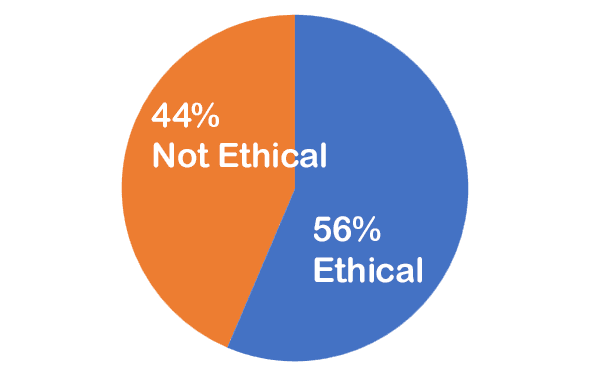
Was it ethical for Engineer Brian to seek to obtain Engineer Alex’s signature to the confidentiality and non-solicitation agreement?
Here is the result of our survey of your peers:
Applicable NSPE Code References:
Code II.4: Engineers shall not disclose, without consent, confidential information concerning the business affairs or technical processes of any present or former client or employer, or public body on which they serve.
Code II.4.a: Engineers shall not, without the consent of all interested parties, promote or arrange for new employment or practice in connection with a specific project for which the Engineer has gained particular and specialized knowledge. Code III.7
Code III.7: Engineers shall not attempt to injure, maliciously or falsely, directly or indirectly, the professional reputation, prospects, practice, or employment of other engineers. Engineers who believe others are guilty of unethical or illegal practice shall present such information to the proper authority for action.
Discussion
The Board has had occasion to consider the issue of restrictive employment agreements in the past. These cases typically involve a balancing of the benefits, responsibilities, and obligations of both the employer and the engineer in the performance of engineering services.
In this case, the Board finds that clauses 1 and 2 are not objectionable because they are consistent with the NSPE Code of Ethics, law, and the general custom and practice within the engineering profession. Clause 3 is generally not prohibited by the NSPE Code of Ethics unless it involves confidential information concerning the business affairs or technical processes of a present or former client or employer and is done without consent. However, clause 4 would appear to be too broad because it would apply to all employed engineers in the company regardless of their tenure with the company and would be binding on the employed engineers (including Engineer Alex) for three years without limitation.
This agreement would appear to totally bar any employment with a competitor for a period of three years under any circumstances. In addition, the agreement is not bound in any way by any geographic limitation. Instead, the agreement would appear to apply to any competitor in the world. Clause 4 would, in essence, force a knowledgeable engineer to remain unemployed in his or her area of expertise or be hired by a company that does not compete with the employer, for a period of three years following termination of employment, regardless of the cause of employment termination. We believe this is unreasonable and on that basis believe that it would be unethical for Engineer Brian to seek to obtain Engineer Alex’s signature on the confidentiality and non-solicitation agreement as it is presently worded.
The Ethical Review Board’s Conclusion
It was not ethical for Engineer Brian to seek Engineer Alex’s signature to the confidentiality and non-solicitation agreement in the manner described.
BOARD OF ETHICAL REVIEW
James G. Fuller, P.E.; William E. Norris, P.E.; Paul E. Pritzker, P.E.; Richard Simberg, P.E.; Jimmy H. Smith, P.E., Ph.D.; C. Allen Wortley, P.E.; Donald L. Hiatte, P.E., Chairman
Note – In regard to the question of application of the Code to corporations vis-a-vis real persons, business form or type should not negate nor influence conformance of individuals to the Code. The Code deals with professional services, which services must be performed by real persons. Real persons in turn establish and implement policies within business structures. The Code is clearly written to apply to the Engineer and it is incumbent on a member of NSPE to endeavor to live up to its provisions. This applies to all pertinent sections of the Code. This opinion is based on data submitted to the Board of Ethical Review and does not necessarily represent all of the pertinent facts when applied to a specific case. This opinion is for educational purposes only and should not be construed as expressing any opinion on the ethics of specific individuals. This opinion may be reprinted without further permission, provided that this statement is included before or after the text of the case.

I agree with what Engineer Bryan is trying to do with the company that he has just been given charge of.
I also agree with Engineer Alex’s stance and I would fight back with Engineer Brian because one Alex’s idea was first brought up within the company Engineer Bryan’s policies weren’t in place
The engineer, Alex, should be congratulated because people like him help the USA to prosper.
I am not an attorney. The last time I consulted an attorney on a similar question, I was advised that #4 was not a legal (enforceable) contract in the subject jurisdiction. My reading of the Code of Ethics is: Not legal = Not Ethical.
The exercise of clause 1 would depend upon the status of any agreement in place prior to the acquisition of the company by new management. If the prior owners had shared rights with Engineer Alex, the new terms would be unenforceable.
The wording of the question seems to indicate only the confidentiality and non-solicitation are the only issues relative to whether the required confidentiality agreement is ethical. If the question generically asked whether the entire confidentiality agreement was ethical, I would agree that it is not ethical.
If Engineer Alex developed a product by the needs and resources of Engineer Bryan’s company, it is fair to ban him of competing or surrender that knowledge to a competitor. Engineer Alex is not forbidden to work and he still can start developing other project.
While I don’t think it is good business practice, I don’t think ethics plays into the request to sign. Alex does not have to sign and can (and should) take his skills elsewhere.
Employment law and rights are the question here, not ethics. It’s mean and unreasonable.
The 4th item in the agreement shows that Engineer Bryan is stupid. To me this demonstrates how being stupid and not thinking things through can lead to unethical behavior. After which CYA actions increase the severity of unethical behavior. “Sign this now or leave” is different from “you have two weeks to decide”. Also as illegal portions of contracts are unenforceable, would Engineer Alex be unethical if he signed and later sued? Also from what I have heard through conversations with people who sold businesses, purchased businesses and lawyers over the years, in order to be effective non-compete agreements have to be both reasonable and specific to be effective and enforceable
Over the course of my career, I have observed that when employees are not happy with their current job or want a change, they will find ways to leave regardless of what types of agreements they are asked to sign. I certainly did when I left my first engineering employer. Parts 1 and 2 of the agreement that “Alex” had to sign are reasonable. Part 3 seems vague. What is its duration, eternity? It would seem to me to be unenforceable unless there were a sunset clause – two years, for example. Part 4 not only contradicts the laws of many states, it is frankly ineffective. If Alex became unhappy with his current employer, he would likely get around it by working in the public or academic sectors for a few years. My advice to people who run engineering firms – don’t try to restrict who people work for after they quit. They will quit anyway.
Number 1 seems to be commonly used by numerous engineering firms, but I regard it as a form of theft. I am selling my services, not my brain.
Number 2 and 3 are reasonable.
Number 4, absolutely not. As a practical matter when changing jobs within the engineering field, quite commonly the new employer will be in some aspects in some areas in competition with the current employer. The particularly nasty part of this item is “regardless of cause of termination.” Which could well mean, we can fire you or lay you off and you cannot work in this field for three years.
The rational thing here is to quit instead of signing such a document.
Coming from a “Right to Work” state, I had been coerced into signing a similar “confidentiality agreement,” including the work restriction of item 4. Prior to signing I consulted with my attorney who indicated item 4 was unenforceable. I signed the agreement. A little over a year later I left and went to work for myself in the exact same line of business, although I was careful not to solicit the prior company’s clients. There was a little saber rattling after I left, but my lawyer quickly crushed it. I never looked back.
Legally unenforceable = not ethical. Engineer Brian was not a very adept manager, relying solely on the legalese of the confidentiality agreement.