






This is the March 2026 edition of our monthly series of Ethics case studies titled What Do You Think? This series is comprised of case studies from NSPE archives, involving both real and hypothetical matters submitted by engineers, public officials and members of the public.
Your peers and the NSPE Board of Ethical Review have reviewed the facts of the case as shown below. And, here are the results.
Your opinion has been registered for the March 2026 edition of our monthly series of Ethics case studies titled What Do You Think?
Your vote is recorded as:

Want to know how your peers voted? We’ll send you an email with the poll results on March 31.
Your opinion has been registered for the March 2026 edition of our monthly series of Ethics case studies titled What Do You Think?
Your vote is recorded as:

Want to know how your peers voted? We’ll send you an email with the poll results on March 31.
A Review of the Facts
Engineer Alice is asked by a firm to prepare specifications for an air compression system. Engineer Alice made the firm aware that she is the President (and major shareholder) of a company that manufactures and sells air compression systems and that she has no problem with preparing a set of generic specifications. Engineer Alice also provides the firm with four other manufacturers that prepare air compression systems for bidding purposes, and Engineer Alice did not include her company as one of the four specified manufacturers.
The firm now wants to meet with Engineer Alice and a salesman from her company. Engineer Alice indicated to the firm that it might be a conflict-of-interest.
Would it be a conflict of interest and therefore unethical for Engineer Alice to prepare a set of specifications for an air compression system and then have her company manufacture the air compression system under the facts?
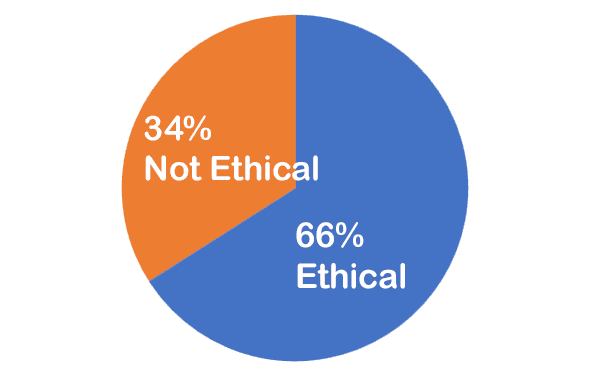
Here is the result of our survey of your peers:
Applicable NSPE Code References:
Code II.4: Engineers shall act for each employer or client as faithful agents or trustees.
Code II.4.a: Engineers shall disclose all known or potential conflicts of interest which could influence or appear to influence their judgment or the quality of their services.
Discussion
The facts in the present case raise a fundamental issue concerning the manner in which engineers may properly provide professional services and specify products from companies which they control, in light of the language contained in the NSPE Code of Ethics Code II.4.a., which requires engineers to disclose all known or potential conflicts of interest that could influence or appear to influence their judgment or the quality of their services.
Although Engineer Alice was the President and major shareholder in a company that manufactured and sold air compression systems, clearly Engineer Alice took all necessary and reasonable steps to disclose all potential conflicts of interest in order to avoid any appearance of a conflict. By immediately disclosing the fact that she had a major interest in an air compression manufacturing company, by suggesting the name of four other alternative manufacturers, and by raising the issue before it surfaces as a result of possible appearances, Engineer Alice has acted consistently with the Code. Unlike the previous provisions of the Code that required the engineer to “avoid” conflicts of interest, the current code acknowledges that conflicts do arise and imposes upon the engineer the responsibility to take all reasonable steps to notify and advise the client – leaving it up to the client whether to proceed with the services of the engineer. It is the Board’s view that Engineer Alice’s conduct was in keeping with Code provision that engineers must disclose all known conflicts of interest which could influence or appear to influence their judgment or the quality of their services.
The Ethical Review Board’s Conclusion
It would not be a conflict of interest, and therefore it would be ethical for Engineer Alice to prepare a set of specifications for an air compression system and then have her company manufacture the air compression system under the facts.
BOARD OF ETHICAL REVIEW
Lorry T. Bannes, P.E., James G. Fuller, P.E., Donald L. Hiatte, P.E., Joe Paul Jones, P.E., Paul E. Pritzker, P.E., Richard Simberg, P.E., C. Allen Wortley, P.E., Chairman
Note – In regard to the question of application of the Code to corporations vis-a-vis real persons, business form or type should not negate nor influence conformance of individuals to the Code. The Code deals with professional services, which services must be performed by real persons. Real persons in turn establish and implement policies within business structures. The Code is clearly written to apply to the Engineer and it is incumbent on a member of NSPE to endeavor to live up to its provisions. This applies to all pertinent sections of the Code. This opinion is based on data submitted to the Board of Ethical Review and does not necessarily represent all of the pertinent facts when applied to a specific case. This opinion is for educational purposes only and should not be construed as expressing any opinion on the ethics of specific individuals. This opinion may be reprinted without further permission, provided that this statement is included before or after the text of the case.

Leave A Comment