





This is the April 2026 edition of our monthly series of Ethics case studies titled What Do You Think? This series is comprised of case studies from NSPE archives, involving both real and hypothetical matters submitted by engineers, public officials and members of the public.
Your peers and the NSPE Board of Ethical Review have reviewed the facts of the case as shown below. And, here are the results.
Your opinion has been registered for the April 2026 edition of our monthly series of Ethics case studies titled What Do You Think?
Your vote is recorded as:

Want to know how your peers voted? We’ll send you an email with the poll results on April 28.
Your opinion has been registered for the April 2026 edition of our monthly series of Ethics case studies titled What Do You Think?
Your vote is recorded as:

Want to know how your peers voted? We’ll send you an email with the poll results on April 28.
A Review of the Facts
Engineer Greg is retained by the U.S. government to study the causes of a dam failure. A Dams R Us is hired by the U.S. government as the contractor on the same project. Later, Engineer Greg is retained as an expert witness by Dams R Us, who has filed a claim against the U.S. government for additional compensation.
Was it ethical for Engineer Greg to be retained as an expert witness for the contractor under these circumstances?
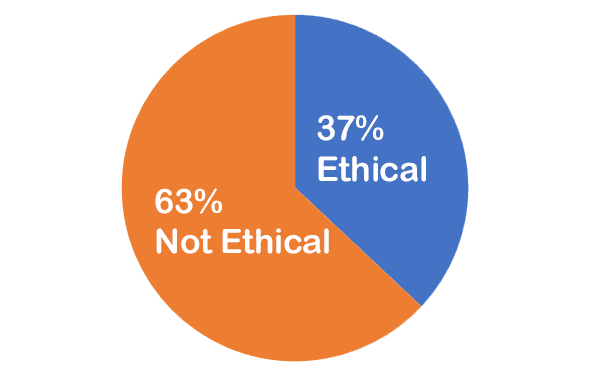
Here is the result of our survey of your peers:
Applicable NSPE Code References:
Code II.4.b: Engineers shall not, without the consent of all interested parties, participate in or represent an adversary interest in connection with a specific project or proceeding in which the engineer has gained particular specialized knowledge on behalf of a former client or employer.
Discussion
The issue presented here was in many ways addressed by this Board in Case 76-3. In that case an engineer, under a retainer agreement with a county to provide water sewage design and expertise, and general advisory services, entered into a second retainer agreement with a developer with county approval. Thereafter, the developer filed a petition with the zoning board to rezone a substantial area of the county for commercial purposes. The county department filed several engineering reports adverse to the zoning petition, recommending denial of the rezoning because the proposed construction would overload available water sewage facilities. The development company then called the engineer as an expert witness at the zoning hearing. The engineer testified in support of the zoning petition.
There we noted that when the engineer appeared before the body which had jurisdiction over the subject matter on behalf of a party whose position was adverse to that of the government while at the same time being an advisor to the government, he at best gave the appearance of trying to be on both sides of a public policy issue. We added that it would be incorrect to accept the engineer’s role as an expert witness in the ordinary sense of that kind of professional service arrangement. The engineer was doing more than offering his expertise in engineering matters as an aid to a fuller understanding by the tribunal; he was in fact a paid advocate of a private interest in open conflict with the engineering opinions of the government. We noted that although the engineer was not required to agree with the government or even support its position at the hearing, if he chose to oppose that position on behalf of an adverse party, he could ethically do so by first resigning from his role as advisor to the county.
The facts presented in the instant case are strikingly similar to those presented in Case 76-3 with one exception. Under the facts of this case, Engineer Greg was paid in full for his services to the government and apparently was no longer retained by the government and was free to oppose its position on behalf of an adverse party. Given the unambiguous language of Case 76-3 noted above, it would appear that Engineer Greg could ethically represent the interests of the contractor as an expert witness in its claim against the government for additional compensation. However, there is one important distinction between Case 76-3 and the case presented here. Case 76-3 was decided under the 1976 Code of Ethics which made no mention of an engineer’s ethical obligation to refrain from representing an adverse interest in a proceeding. In July 1981, the Code of Ethics was revised. Code III.4.b. amended and refined the older Code 7 to read: “Engineers shall not, without the consent of all interested parties, participate in or represent an adversary interest in connection with a specific project or proceeding in which the engineer has gained a particular specialized knowledge on behalf of a former client or employer.”
Under the revised Section it is clear that Engineer Greg’s action was in violation of Code III.4.b. There is nothing in the record to indicate that Engineer Greg was given the consent of his former client, the U.S. government, to represent the interests of the contractor in its claim against the government for additional compensation.
In addition, we have no doubt that the expert testimony offered by Engineer Greg in a legal proceeding would constitute “particular, specialized knowledge gained on behalf of a former client or employer.” As an expert witness, Engineer Greg would be required to state his opinion based upon his firsthand knowledge and on facts of record. There is a danger that Engineer Greg’s opinions, based on his firsthand knowledge and his understanding of the facts of record, would touch upon privileged, specialized, and confidential knowledge gained while he was retained by the U.S. government. Indeed, he may be called upon to give an opinion as to the very facts with which he was involved as a consultant with the government. There can be no doubt that Code III.4.b. was enacted to prevent engineers from disclosing such information. For those reasons we find that it would be unethical for an engineer who was retained by the U.S. government to be retained as an expert witness for a contractor who filed a claim against the U.S. government for additional compensation.
The Ethical Review Board’s Conclusion
It was not ethical for Engineer Greg to be retained as an expert witness for the contractor under these circumstances.
BOARD OF ETHICAL REVIEW
Ernest C. James, P.E. Lawrence E. Jones, P.E. Robert H. Perrine, P.E. James L. Polk, P.E. J. Kent Roberts, P.E. Alfred H. Samborn, P.E. F. Wendell Beard, P.E., chairman
Note – In regard to the question of application of the Code to corporations vis-a-vis real persons, business form or type should not negate nor influence conformance of individuals to the Code. The Code deals with professional services, which services must be performed by real persons. Real persons in turn establish and implement policies within business structures. The Code is clearly written to apply to the Engineer and it is incumbent on a member of NSPE to endeavor to live up to its provisions. This applies to all pertinent sections of the Code. This opinion is based on data submitted to the Board of Ethical Review and does not necessarily represent all of the pertinent facts when applied to a specific case. This opinion is for educational purposes only and should not be construed as expressing any opinion on the ethics of specific individuals. This opinion may be reprinted without further permission, provided that this statement is included before or after the text of the case.

Leave A Comment