





Date: March 2, 1973
Location: Bailey’s Crossroads, Fairfax County, Virginia
Fatalties: 14
Injuries: 34
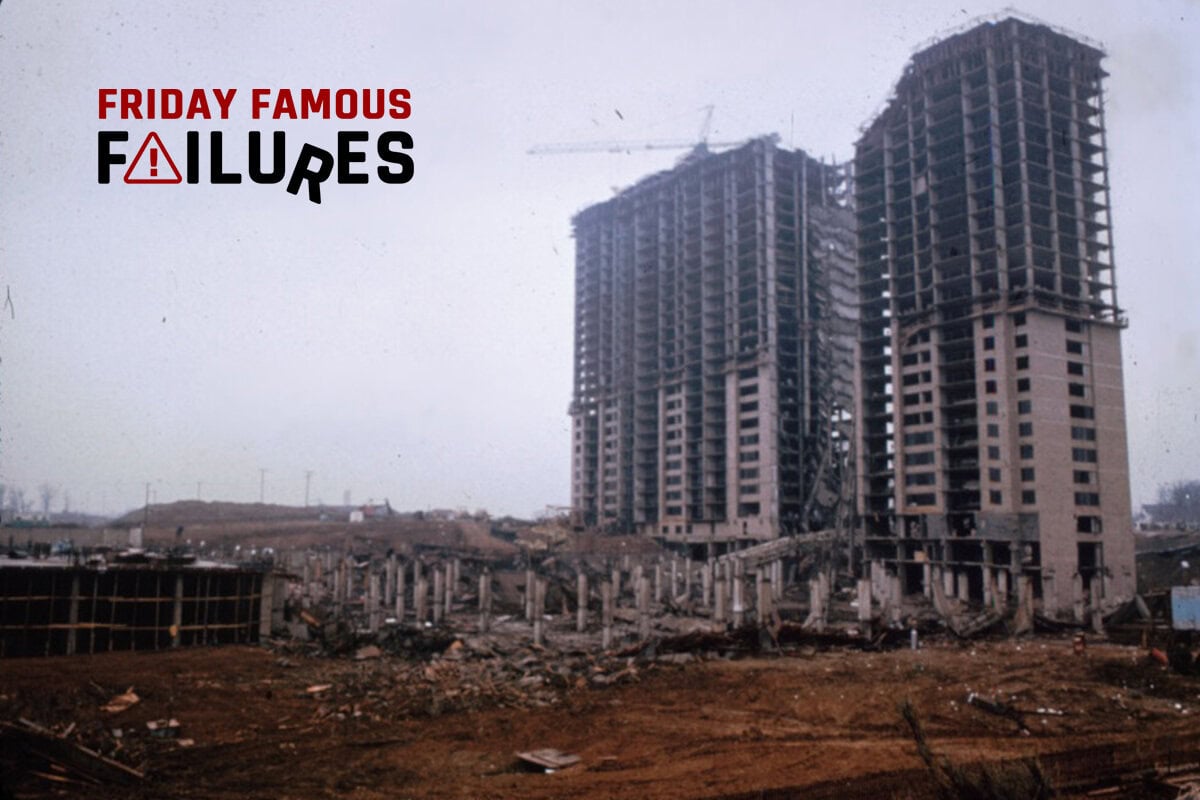
On March 2, 1973, a partially completed 26-story reinforced concrete apartment building at Bailey’s Crossroads in Fairfax County, Virginia, suffered a catastrophic collapse. In seconds, a structure that had been rising steadily toward completion failed from the top down, killing 14 construction workers and injuring more than 30 others. The Skyline Plaza collapse remains one of the most instructive case studies in construction-stage risk, where the design itself was largely sound, but execution proved fatal.
A Project Built for Speed
The Skyline Plaza development was envisioned as a large residential complex in Northern Virginia, consisting of hundreds of condominium units in a rapidly growing market.
Like many large-scale projects of the era, schedule pressure was significant. Units had already been sold, and construction was moving aggressively toward completion. On the day of the collapse, concrete placement was actively occurring on upper floors while lower-level formwork and shoring were being removed.
The overlap of construction above and support removal below set the stage for failure.
What Caused the Failure?
At approximately 2:30 PM, workers were placing concrete on the 24th floor while shoring was being removed from floors below, particularly the 22nd and 23rd levels.
Within moments, a localized failure occurred in the 23rd-floor slab. That failure rapidly propagated downward, resulting in a progressive collapse that extended nearly the full height of the structure. The building was left with a massive vertical void, appearing almost as two separate structures.
Initial speculation pointed to crane failure, but forensic investigation would later reveal a far more fundamental issue, the structure was asked to carry loads it was not ready to support.
- Punching shear failure at slab-column connections
- Premature removal of shoring eliminated critical load support
- Concrete strength was insufficient at the time of loading
- Construction sequencing deviated from design requirements
- Progressive collapse propagated through a partially cured structure
Punching Shear Failure at the Slab-Column Interface
The National Bureau of Standards determined that the collapse began with a punching shear failure of the 23rd-floor slab around its supporting columns. This type of failure is particularly dangerous because it is sudden and brittle, with little warning.
Flat plate systems depend heavily on slab-column connections. When these connections fail, loads cannot redistribute effectively. In this case, once the slab failed locally at several columns, the remaining structure could not absorb the increased stresses, and collapse initiated almost immediately.
Premature Removal of Shoring
The structural design required two floors of shoring and one floor of reshoring beneath the active concrete placement. These temporary supports were essential to distribute loads across multiple floors while the concrete gained strength.
However, field practices did not follow this requirement. Shoring was removed too early, eliminating the intended load-sharing mechanism. As a result, the partially cured slab was forced to carry loads that should have been distributed through the shoring system.
Insufficient Concrete Strength
At the time of collapse, the concrete in the critical slab region had not reached its design strength. Estimates suggest compressive strength may have been as low as 1,200 psi compared to a design value of 3,000 psi.
Despite this, the slab was subjected to its own weight, the weight of freshly placed concrete above, and construction loads. This mismatch between assumed and actual strength was a central factor in the failure.
Construction Sequencing Deviations
Construction sequencing is not simply a logistical concern; it directly affects structural behavior. The design clearly specified the required sequencing for shoring and reshoring, yet these requirements were not followed in the field.
Removing supports while simultaneously adding load created a condition where demand exceeded capacity. This was not a hidden or complex issue, but rather a breakdown in adhering to known requirements.
Progressive Collapse Mechanism
Once the 23rd-floor slab failed, the structure experienced a classic progressive collapse. The failed slab dropped onto the floor below, imposing impact loads far greater than those considered in design.
Each successive floor, also partially cured and insufficiently supported, failed in turn. The collapse continued downward through multiple levels, demonstrating how a localized failure can propagate when redundancy is limited during construction.
Engineering Lessons
Construction stages must be treated as critical design conditions, since structural behavior during construction can differ significantly from that of the completed structure. Temporary works, including shoring and formwork, function as integral structural systems and require the same level of engineering and oversight as permanent components. At the same time, concrete strength development must be verified based on actual in-place conditions rather than assumed design values, particularly in flat plate systems that are more susceptible to punching shear during early loading. These factors are closely tied to construction sequencing, which must be approached as a structural issue, not simply a scheduling decision, because the timing of loading and support removal directly influences load paths and overall stability.

Leave A Comment