





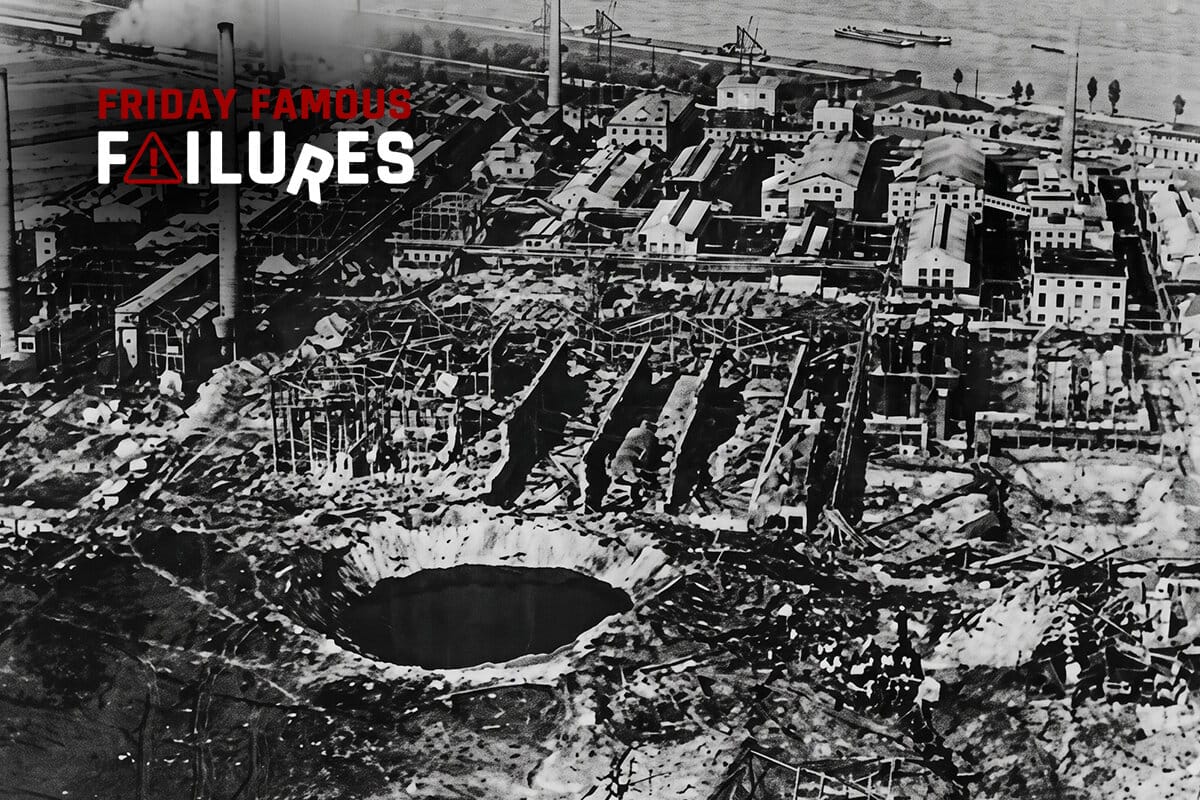
Date: September 21, 1921
Location: Oppau, Germany, now part of Ludwigshafen
Facility: BASF nitrogen fertilizer plant
Outcome: More than 500 people killed; nearly 2,000 injured
Primary failure mechanism: Detonation of stored ammonium sulfate nitrate fertilizer after explosive charges were used to break up caked material
On the morning of September 21, 1921, a massive explosion tore through BASF’s nitrogen fertilizer plant at Oppau, Germany. The blast destroyed much of the plant, devastated the surrounding town, and became one of the deadliest industrial explosions in history.
The material involved was not being stored as a military explosive. It was fertilizer: ammonium sulfate nitrate, a mixed salt containing ammonium nitrate and ammonium sulfate. The plant had used small explosive charges many times before to loosen hardened fertilizer in storage silos. The practice had come to be regarded as acceptable because earlier experience and testing suggested the product would not detonate under those conditions.
On that morning, the assumption failed catastrophically.
For engineers, the Oppau disaster is a classic process-safety case study. It shows how a material believed to be stable can become hazardous when production conditions, physical properties, composition, storage behavior, and handling practices change. It is also a warning about relying on historical success as proof of continuing safety.
A Fertilizer Built From Industrial Innovation
The Oppau plant was part of the early industrial age of synthetic nitrogen. The Haber-Bosch process made it possible to produce ammonia at large scale, allowing Germany to manufacture nitrogen compounds without depending entirely on imported nitrate sources. That technology had enormous agricultural and strategic importance.
At Oppau, ammonium nitrate was combined with ammonium sulfate to make ammonium sulfate nitrate fertilizer. Ammonium nitrate was known to have explosive potential, while ammonium sulfate was comparatively inert. At the time, the mixed product was believed to be safe if the ammonium nitrate content remained below a critical threshold. The product handled at Oppau was nominally a roughly 50:50 mixture.
But the fertilizer had an operational problem. During storage, it could absorb moisture, compact under its own weight, and form hard, plaster-like masses. Workers needed to break up the caked material so it could be removed and shipped. Entering the silo and attacking the mass manually could itself be dangerous, so the plant used small explosive charges to loosen the hardened fertilizer.
Before the disaster, this method had reportedly been used thousands of times without a notable incident. That history was important—but also misleading. The operation had become normalized.
What Caused the Failure?
The immediate initiating event was the use of explosive charges to break up caked ammonium sulfate nitrate fertilizer. But the deeper failure was that the safety basis for that practice no longer matched the material actually present in the silo.
Earlier assumptions focused heavily on chemical composition, especially the ratio of ammonium nitrate to ammonium sulfate. If the mixture stayed near the intended 50:50 composition, it was believed to be insufficiently sensitive to detonate under the blasting procedure used at the plant.
Later analysis showed that this was too narrow. Explosive sensitivity was not governed only by the average chemical ratio. Physical properties mattered as well. Smaller particle size, lower density, reduced water content, stronger confinement, booster strength, and inhomogeneity could all affect whether the material responded violently to a detonation stimulus.
The new drying process changed several of those variables. It likely produced a more porous, drier, lower-density material and a fine fraction with higher ammonium nitrate content. If a blasting charge was placed in or near a sensitive region, that localized detonation could act as a booster and initiate additional material that might not otherwise have been expected to detonate.
The final event was therefore not simply “fertilizer exploded.” It was a loss of process-safety control caused by a changed material, an accepted but hazardous handling method, and an incomplete understanding of explosive behavior.
More Than a Blasting Error
It would be too simple to blame the disaster only on the workers who placed the charges. They were following an established practice that had been used many times before. The more important lesson is that repeated success under one set of conditions does not prove safety after process conditions change.
The production change was central. When a process change alters moisture, density, particle size, segregation, crystal structure, or chemical distribution, it can alter the hazard classification of the material. For energetic or potentially energetic materials, even small changes can have large consequences.
Oppau also illustrates the danger of average values. A silo may test within specification on average while still containing local regions that are more hazardous. Bulk storage can create gradients, layers, segregated fractions, dead zones, and localized compositions that are not captured by routine sampling. In a high-energy system, a small sensitive region may be enough to initiate a much larger event.
Engineering Lessons
The first lesson is that material properties are part of the process safety basis. Chemical composition alone is not enough. Engineers must consider particle size, density, moisture content, porosity, confinement, contamination, crystal structure, and segregation.
The second lesson is that management of change is essential. A process change that improves production, drying, throughput, or product quality can also change hazard behavior. When the drying process changed at Oppau, the old safety assumptions should have been revalidated against the new material.
The third lesson is that “we have always done it this way” is not a safety argument. Thousands of successful operations may simply mean that the system has not yet encountered the wrong combination of conditions.
The fourth lesson is that bulk storage can hide local hazards. Average composition and routine samples may not reveal enriched layers, fines, or isolated pockets of sensitive material.
The fifth lesson is that energetic handling methods require extraordinary scrutiny. Using explosive charges to break up industrial material may appear controlled, but it deliberately introduces a detonation stimulus into a stored chemical mass. That practice demands a safety margin that is based on conservative testing, not operational habit.

Leave A Comment