





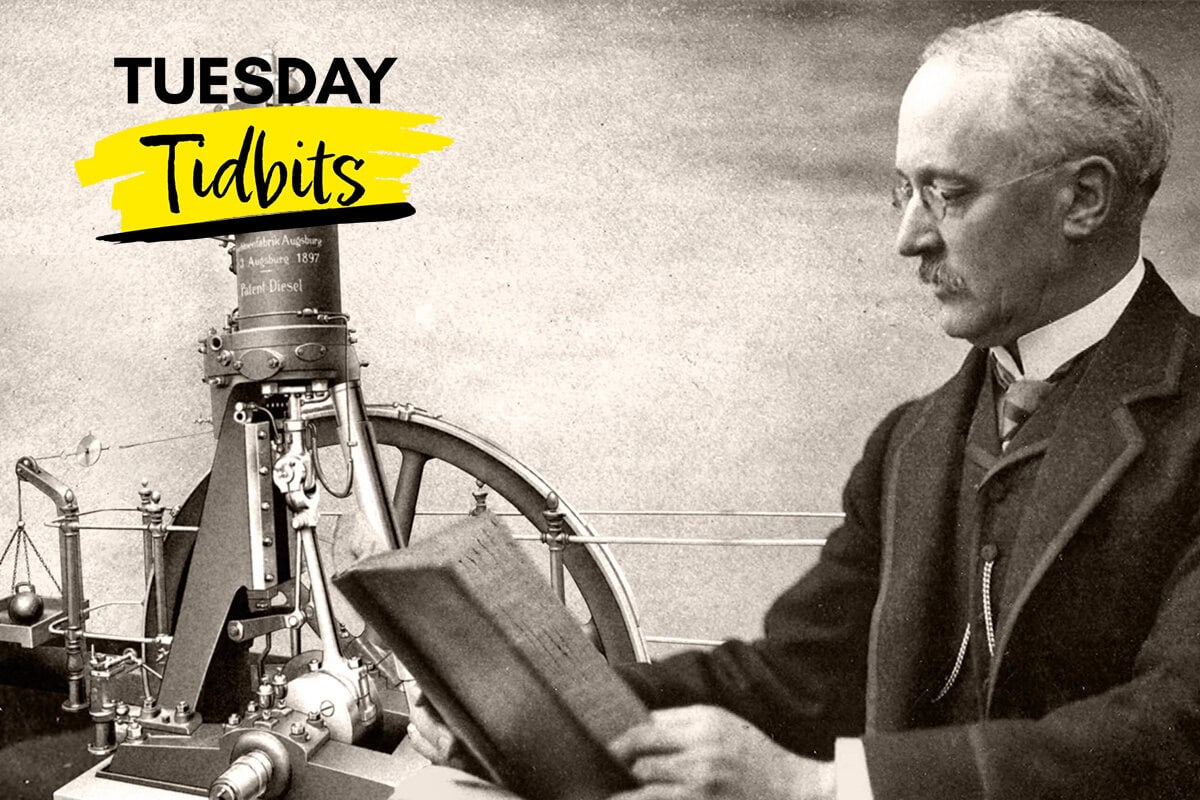
In the late 19th century, as industry expanded and demand for mechanical power surged, engineers faced a persistent challenge: extracting more utility from fuel. Steam engines had powered the Industrial Revolution, but they were bulky, inefficient, and limited by thermodynamic losses. Into this landscape stepped Rudolf Diesel, a mechanical engineer whose pursuit of efficiency would lead to one of the most impactful innovations in modern engineering: the diesel engine.
Diesel’s work was not simply an incremental improvement. It represented a fundamental rethinking of how engines convert heat into mechanical energy, grounded in thermodynamic principles that remain central to engineering practice today, evident by his immediately recognizable namesake.
The Problem of Efficiency
By the 1890s, steam engines and early internal combustion engines were widely used, yet both suffered from significant inefficiencies. Steam engines required large boilers, consumed vast amounts of fuel, and lost energy through heat transfer and condensation. Early gasoline engines, while more compact, relied on spark ignition and relatively low compression ratios, limiting their thermal efficiency.
Diesel, who studied under thermodynamicist Carl von Linde at the Royal Bavarian Polytechnic in Munich, became deeply interested in the theoretical limits of engine performance. He focused on the concept of maximizing efficiency by increasing the temperature difference in the thermodynamic cycle, a principle derived from Carnot efficiency. He sought to approach these theoretical limits, initially envisioning an isothermal process, though practical designs evolved into what we now recognize as the diesel cycle.
Rather than accepting the limitations of existing designs, Diesel set out to create an engine that operated closer to ideal thermodynamic conditions.
A Radical Approach to Combustion
Diesel’s key insight, to use compression alone to ignite fuel, was simple but transformative.
In a diesel engine, air is compressed to a much higher pressure than in gasoline engines. This compression raises the air temperature to a point where injected fuel ignites spontaneously. The result is a compression ignition engine that operates at significantly higher efficiency.
The resulting thermodynamic model, now known as the diesel cycle, differs from the Otto cycle by introducing constant-pressure heat addition rather than constant-volume combustion. Typical diesel engines operate at compression ratios ranging from approximately 14:1 to 25:1, significantly higher than gasoline engines.
This approach introduced several advantages in engineering:
- Higher compression ratios, leading to improved thermal efficiency
- Elimination of spark ignition systems
- Greater fuel flexibility, including heavier and less refined fuels
- Increased durability under continuous operation
This simplification of ignition systems came at the cost of highly precise fuel injection requirements. The development of reliable high-pressure fuel injection systems has become a critical enabling technology for practical diesel engine operation.
However, turning this concept into a working machine required overcoming substantial engineering challenges. Early prototypes suffered from extreme pressures, material failures, and even catastrophic explosions. Diesel persisted through years of trial and error, refining injection timing, fuel atomization, and cylinder design.
In 1897, Diesel and his collaborators successfully demonstrated a working engine in Augsburg, Germany. It achieved efficiencies approaching 25 to 30 percent, significantly higher than many steam engines of the era, which often operated below 10 percent, marking a turning point in mechanical engineering.
Engineering Impact and Industrial Adoption
The diesel engine quickly proved its value in industrial applications. Its ability to operate efficiently under heavy loads made it ideal for marine propulsion, rail locomotives, power generation, and heavy machinery, to name a few applications.
Unlike steam engines, diesel engines did not require large boilers or extensive warm-up periods. This made them more practical, more compact, and often safer in operation, particularly due to the elimination of high-pressure steam boilers.
As materials science and manufacturing techniques improved, diesel engines became more reliable and scalable. By the early 20th century, they were widely adopted across industries, fundamentally reshaping transportation and infrastructure.
Even today, diesel engines power a substantial majority of global freight transport, underscoring the enduring relevance of Diesel’s original design.
Legacy and Modern Relevance
Rudolf Diesel’s influence extends far beyond his original invention. The diesel cycle remains a foundational concept in thermodynamics and mechanical engineering education. Modern engines continue to build on his principles, incorporating advanced fuel injection systems, turbocharging, and emissions controls.
At the same time, Diesel’s work raises ongoing engineering challenges. Environmental concerns, particularly related to emissions, have driven innovation in cleaner combustion technologies and alternative fuels. Engineers today continue to refine and adapt diesel-based systems to meet evolving regulatory and sustainability requirements.
Despite these challenges, the core idea—using compression to achieve efficient combustion—remains as relevant as ever.
Conclusion
Rudolf Diesel’s story is a reminder that transformative engineering often begins with a simple question: how can this be done better?
In an era increasingly focused on sustainability and resource optimization, Diesel’s pursuit of efficiency feels especially timely. His engine did more than power machines; it reshaped how engineers think about energy, performance, and possibility.
From the factory floors of the 19th century to the global infrastructure systems of today, Rudolf Diesel’s legacy continues to move the world, one efficient cycle at a time.

Leave A Comment