





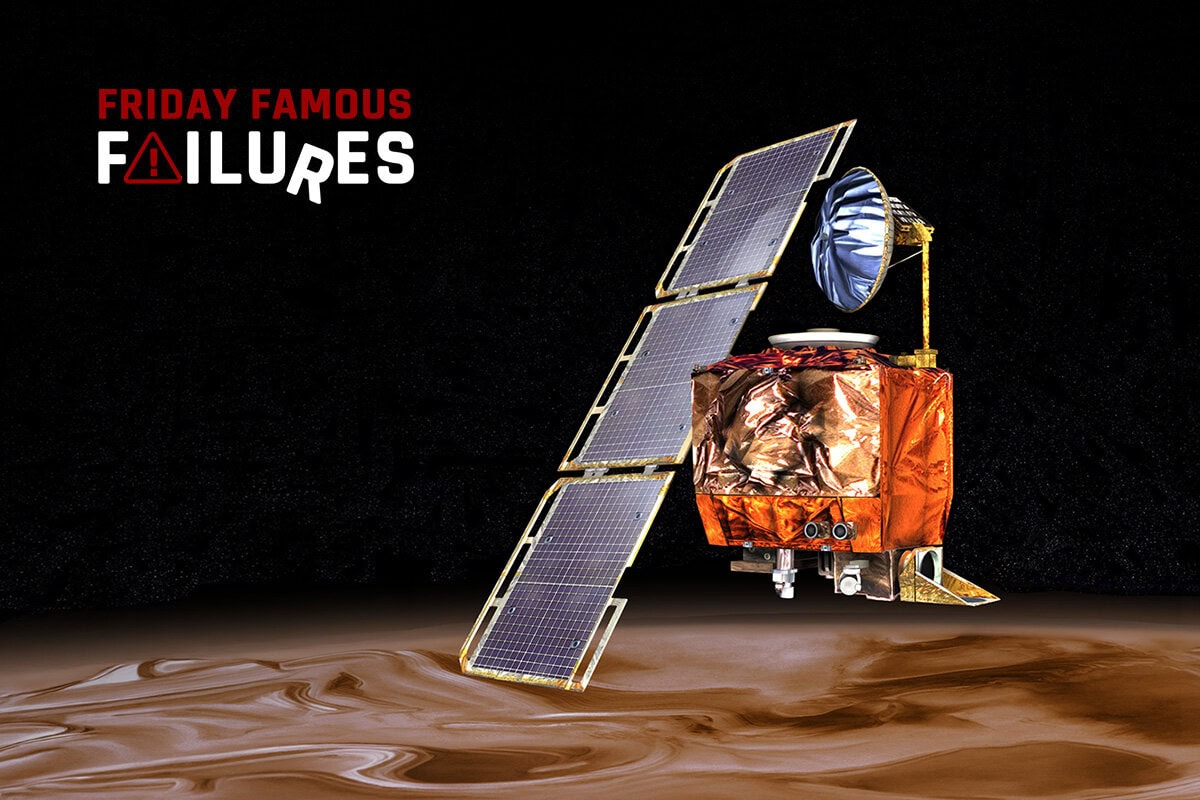
Date: September 23, 1999
Mission phase: Mars Orbit Insertion, near Mars
Mission: NASA Mars Climate Orbiter
Outcome: Spacecraft lost on arrival at Mars
On September 23, 1999, NASA’s Mars Climate Orbiter was expected to enter orbit around Mars after an approximately nine-and-a-half-month cruise from Earth. Instead, its carrier signal was lost during Mars Orbit Insertion (MOI) and was never reacquired. NASA’s mission summary describes the cause in terms familiar to engineers: ground software used English units while other systems treated the data as metric, sending the spacecraft too close to Mars.
The spacecraft launched on December 11, 1998, from Cape Canaveral aboard a Delta II launch vehicle. Its mission was to study Mars from orbit and serve as a communications relay for the Mars Polar Lander and other probes. By arrival, mission success depended on repeated small-force trajectory modeling, correct interpretation of an Angular Momentum Desaturation file, and clear communication between spacecraft, navigation, and operations teams.
A Mission Built on Small Corrections
The Mars Climate Orbiter used reaction wheels to control attitude and thruster firings to manage accumulated angular momentum. These Angular Momentum Desaturation (AMD) events were not the major MOI burn. They were routine attitude-control desaturation maneuvers, but their cumulative effects still had to be modeled accurately during cruise.
After each AMD event, the SM_FORCES ground-software application processed spacecraft data and generated output contained in an AMD file. The Software Interface Specification required the impulse-bit data in that file to be in newtonseconds. Instead, the ground software reported it in pound-force-seconds. Because one pound-force equals approximately 4.45 newtons, downstream navigation processing underestimated the effect of the thruster firings by a factor of 4.45.
The failure was not a novel physics problem. It was an interface-control and verification failure in which a valid-looking number carried the wrong unit.
What Caused the Failure?
The root cause was the failure to use metric units in the coding of the SM_FORCES ground-software application used in trajectory modeling. The Software Interface Specification required the AMD-file impulse-bit data to be in newton-seconds. Instead, the data was reported in pound-force-seconds. Downstream navigation processing treated the data as metric and therefore underestimated the effect of the thruster firings by a factor of 4.45. The onboard spacecraft software used metric units correctly; the mismodeling occurred in the ground software and subsequent navigation processing.
For engineers, this is the uncomfortable part of the story. The root cause was not an unknown material behavior, an unforeseeable environmental load, or a failure of orbital mechanics. It was a unit mismatch at an interface. Most engineering disciplines see the same class of risk: inches versus millimeters, psi versus kPa, gallons per minute versus liters per second, foot-pounds versus newton-meters, Fahrenheit versus Celsius.
More Than a Conversion Error
It is tempting to summarize the failure as “NASA lost a spacecraft because someone forgot to convert units.” This is an incomplete summary.
The investigation board identified broader contributing causes: undetected mismodeling of spacecraft velocity changes; navigation-team unfamiliarity with spacecraft characteristics; failure to perform TCM-5; a systems-engineering process that did not adequately address the transition from development to operations; inadequate communications; inadequate operations-navigation staffing; inadequate training; and verification and validation that did not adequately address the ground software.
The TCM-5 finding should be framed carefully. The board found that TCM-5 could have been used shortly before MOI as an emergency maneuver to attain a safer altitude, but the analysis, tests, and procedures needed to commit to it for a safety issue had not been completed. The operations team was not prepared to execute it.
The verification failure is equally important. The Software Interface Specification existed, but it was not properly used in small-forces ground-software development and testing. End-to-end testing to validate the software against the specification did not appear to have been accomplished, and the interface-control process was not completed with sufficient rigor.
Communication and Escalation
The investigation also found that trajectory concerns were not communicated effectively to spacecraft operations or project management. The operations navigation team was somewhat isolated, and conflicts in the data were handled through email rather than formal problem-resolution processes such as the Incident, Surprise, Anomaly reporting procedure. NASA’s report concluded that failing to use the problem-tracking system contributed to the issue slipping through the cracks.
That lesson applies beyond aerospace. Engineering organizations often have formal anomaly, nonconformance, and corrective-action systems, but those systems only work when concerns are entered, tracked, assigned, resolved, and elevated. Informal concern is not the same as formal risk closure.
Engineering Lessons
The Mars Climate Orbiter failure shows that units are not cosmetic labels. Units are part of the engineering requirement. They belong in interface definitions, test plans, software variables, review checklists, simulation inputs, and acceptance criteria.
Interface documents must also be verified in operation. A specification that says “newton-seconds” does not protect a mission unless delivered software and downstream workflows are tested to confirm that the output actually uses newtonseconds.
Small errors can accumulate into catastrophic failures. The thruster modeling error did not appear as a single dramatic event. It accumulated through repeated small trajectory-modeling errors until the spacecraft’s path diverged from the expected one.
Finally, technical concerns must have a clear escalation path. A project culture that allows unresolved anomalies to remain informal is relying on luck rather than engineering control.

AHEM, DO NOT USE METRIC UNITS. USE SI. There are metric units that DO NOT EXIST IN SI. SI should be used. Also, when dealing with Imperial/English units use the IEEE standard for conversion which includes tolerances.